Tuesday, January 12, 2010

Why, what's this bag?


Why, it appears to be a cake!


An hours-old, hand-made baumkuchen from a generations-old recipe and a generations-old oven!


This photos are of the cake I got from the Cake Box, taken right after I left. I need to reiterate that it was way tastier than its machine-made Japanese counterparts.

Saturday, January 2, 2010

On Scalability, Infinite

Anyone with an obsession will get asked, "Why?" It's unavoidable. I don't have a great answer for why I love rotisserie cakes. However, I've got a few rationalizations: the novelty, the effort required, the infinite scalability.

Infinite scalability?

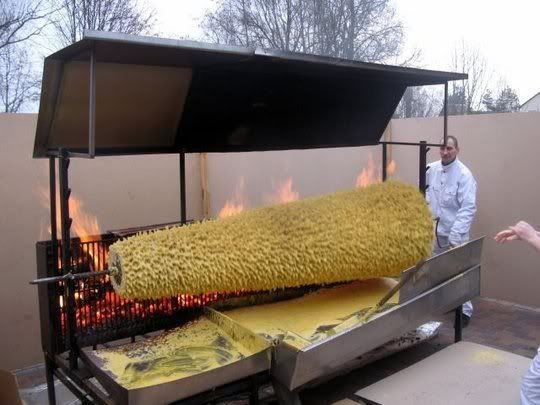
Yeah, this is the one that I have had the hardest time explaining to people. The diameter of your rotisserie cake is limited only by how tall your baking area is. The length of your rotisserie cake is limited only by how long your baking area is. We could theoretically build incredibly long ovens, churning out fifty-foot-long spitcakes, and/or incredibly voluminous ovens, producing cake monsters that are wider than you are tall. Giant cakes.

I never had a really good picture to illustrate this concept, until tonight. Ethan R. found the picture that I've always wanted (but never thought existed). It's part of a story about Lithuanians (my people!) baking a world-record Šakotis. Šakotis is the Lithuanian rotisserie cake! The primary difference between it and baumkuchen is that šakotis batter is dribbled unevenly onto a conical form, and baumkuchen batter is brushed evenly onto a cylindrical form. But I digress.


Look at that. It is the 67.4 kg (148.6 lb), 2.3 m long (7.5 ft), .5 m diameter (1.6 ft) triumph of pastrydom.

Original article

Returned from Cake Box

Cake Box is a fantastic place. A very European shop with very European service. I immediately purchased a large chunk of chocolate-glazed baumkuchen, then spent about twenty minutes just chatting with the proprietors. Chef Paul Gauweiler is probably the only Baumkuchen artisan within 2000 kilometers, and I got to chat with him and his wife/sous-chef! They were unabashedly excited to learn that there are youths who want to keep the traditional Baumkuchen-making methods alive.

Their baumkuchen oven, an 80 year old dual-gas-electric machine, sits in the corner of the shop, in plain view. They wouldn't let me take pictures, but it did look an awful lot like a 55-gallon metal drum slit lengthwise.

Anyway, the cake. It was much moister than the flatkuchen Eidolon and I made earlier, but the flavor was about the same (in other words, phenomenal). The layers were just a wee bit thinner than ours were, but still much larger and more uneven than the Japanese machine-made ones. Overall, it makes me think that I could make Baumkuchen if I really tried!

Wednesday, November 25, 2009

Cake Box, Huntington Beach, CA

The Nov. 23 2009 issue of The New Yorker has a short filler piece about Baumkuchen. Oh my gaaaawwwwwd. It's a little rambly, but it explains the taste and introduces others who share my passion for rotisserie cakes.

Oh, by the way, remember me? I used to post about my cake obsession here. Hi.

Right. Anyway. The article started to rekindle my desire for my own Baumkuchen oven! It also announced that there is a location in Orange County where one can observe a Baumkuchen in construction. It's called The Cake Box, and I am super-stoked to visit there some day when I have an entire afternoon free. When's the next time I will have an entire afternoon free? Probably some time in 2010. Hooray college!

Works cited: Sheraton, Mimi. "Spit Cake." The New Yorker 23 Nov. 2009: 54-57. Print.

Tuesday, March 10, 2009

Remember me?

Oh, hey guys. I'm still around. College pretty much destroys any opportunity to have Project Time.

In the time since cake weekend—which was LAST YEAR—I've gotten cleared to use the machine shop and I've snagged some nice insulation to keep my operations toasty. It's possible that I'll be able to use that instead of extra heating elements (see last post) to get that Baby George rotisserie up to the necessary 250°C.

In the meantime, I have a new Engineering Design project to work on for the final quarter of the school year! My team of four is doing something (not sure exactly what yet) regarding clay cookstoves in Malawi. Efficient heat movement is important! It sounds like I can maybe learn things that also apply to baking cakes. Win/Win!

Sunday, December 28, 2008

Cake Weekend Day 1

THIS WEEKEND IS CAKE WEEKEND

THE ORIGINAL DECISION WAS THAT BY THE END OF THIS WEEKEND THERE WOULD BE A CAKE MACHINE BUILT

MUCH ENTHUSIASM IS NEEDED

I AM SO ENTHUSIASTIC I CANNOT TURN OFF CAPSLOCK

Okay, enough of that. Here's the documentation.

Day 1: Saturday

Saturday began with Raymond driving over with a George Foreman desktop rotisserie. We had determined the night prior that finishing the full-size cake oven would definitively be impossible, as we had yet to find a satisfying balance of light weight, low cost, and sufficient strength. We settled for making a smaller oven using a readily available rotisserie assembly—as a prototype, mind you, and nothing else—and perhaps a tiny cake.


It looks like a cheap temperature sensor, but hey, it goes all the way to 300°C (571°F) which is great for an application where the optimum temperature is 240-260°C (464-500°F). Oh geez it's displaying Fahrenheit whoops how did that happen.


Tinsnips! This is to make a hole for the temperature sensor.


Pieces folded back, hole punched with an awl.


Hmmm...


Well, let's see what's inside.


Oh hey look at that, the oven's reassembled! It's all ready to go and we can see at what temperature the rotisserie peaks. If we can easily get it up to 250°C, we are good!


Oh geez it's still reading Fahrenheit.


The oven peaked around 207°C (405°F), which is NOT YET HOT ENOUGH.


Well, if we can fit another heating element in there, it should get to 250°C just fine, right? Raymond shows me that bending a heating element (such as the one in the bottom right corner of this picture) shorts it out and renders it useless. My bad. I guess we need something more compact...


The solution is more George Foreman! $5 and a quick trip down the block lands us the Lean Mean Something Something.


Here it's been gutted and the heating elements extracted.


These compact little guys will be mounted, one on each side wall of the oven. Did that make sense? I mean here:


...and here:


To fasten them on, we create little aluminium brackets which will be screwed onto the sides shown above.


Side view of bracket.


At this point, it was kind of late and time for Raymond to depart. And neither of us will have much time for cake weekend on Sunday, so it looks like cake weekend is a bust. Well, significant progress was made, I guess. Good thing I still have half a store-bought 'kuchen in the fridge.


Partial success!

Things to remember for next time
  • Raymond. Dude. Check your tyre pressure.

  • That's about it, really. The rest of this is more or less flyin' blind with no preparations.

Tuesday, November 25, 2008

What the engineering profs have to say

Here's the feedback I've gotten recently:

  • It must be electric. Amateur gas pipes mean propane will accumulate at the top of the box, which is way bad.

  • Ceramic bulbs for heating and fireclay for insulation. YES.

  • Depending on the motors being used, it may be best to connect the motor to the spit with a bike chain? It is not difficult to cut sprockets for those so speed control should be much simpler this way. Watch your fingers.

  • One of the traditional recipes I had been looking at (I should make a post for traditional recipes later) is extremely bitter tasting and should not be trusted at all.

  • With fireclay, weight will be an issue, especially with mobility.

  • Safety features! Digital temperature sensors are apparently pretty simple to implement? Also there absolutely must be emergency vents if the oven area gets too hot or any of the structural integrity is compromised.

  • Make many more drafts and don't get too attached to any of them.

  • CAAAAAAAAAAAAAAAAAAAAAAAAKE