Showing posts with label cake machine. Show all posts

Saturday, September 26, 2015

FINALLY, rotisserie cake!

I did it. I baked a cake on a rotisserie.

Let me cut right to the chase: why hadn't I done this yet? I don't have a very good reason. Many many years ago, I thought I'd have to mod a kitchen rotisserie to put out more heat, but Klaus Taesler showed me that wasn't the case. Since then, it's just been my hesitation and equivocation. It's hard to justify buying bulky kitchen appliances that rarely get used (what Alton Brown calls "unitaskers"). Then, not too long ago, I realized, if there's anyone who can justify buying a rotisserie for cake, it would be me!

A little time on Craigslist later, and I had a George Jr. rotisserie! This one's not the same as the Baby George rotisserie I obtained many years ago. This George Jr. is larger and gets hotter than the Baby George, both good things. Besides, Baby George is thousands of miles away in my parents' garage.

All told, the process wasn't as tough as I'd thought, and the result was great! I used the portions from retired engineer Wayne Schmidt's page. A bit embarrassing to publish a recipe in imperial units, but here we go:

INGREDIENTS (in chronological order)

  • 1.5 sticks (12 tbsp) butter, softened
  • 3/4 cup granulated sugar
  • 10 egg yolks
  • 1 shot brandy (I used apple brandy, Klaus Taesler uses cherry brandy)
  • 1 teaspoon vanilla
  • 1/4 teaspoon salt
  • 1 cup all-purpose flour
  • 1/2 cup cornstarch
  • 10 egg whites
  • 1/4 cup granulated sugar

THE PROCESS

  1. In a large bowl, cream the butter and 3/4 cup sugar.
  2. With mixers on low, add egg yolks one or two at a time.
  3. Add brandy, vanilla, and salt.
  4. Sift in flour and cornstarch until uniform.
  5. Wash your mixing apparatus. We're gonna make a meringue, so we have to keep all the oils away.
  6. In a medium or large bowl, beat the egg whites with mixers on high. Beat until the whites have roughly doubled in size.
  7. Add the 1/4 cup sugar and continue to beat until you reach medium-to-stiff peaks.
  8. Fold the meringue into the other ingredients in 3 or 4 stages. Fold just until the mix is homogeneous.
  9. Wrap the baumtüber in foil. If desired, bind with butcher's twine as if it were a porchetta.
  10. Turn on the rotisserie and let the baumtüber come to temperature.
  11. MAKE THE CAAAAAAKE

As you've probably gathered, I live-tweeted the whole process, which was fun. Each layer took 3-6 minutes, depending on how distracted I got. Some layers got browner, others did not. As a result, the layering is irregular and very subtle. No tree-rings.

But how did it taste? In a word: delightful. The texture of the layers stands out as the most noticeable feature in your mouth. The taste is pound-cakey but less sweet (again, perfect for pairing with coffee, tea, chocolate, jam, milk, &c., &c...). But it is quite dry! This is something I noticed in Klaus' counter-top-rotisserie cake as well. Cooking the layers at a lower temperature means they dry out more. I think the brandy also contributed to the dryness. Time to experiment and find out!

Finally, please enjoy a video of me pouring batter while listening to DJ Robert Drake on WXPN:

Sunday, June 7, 2015

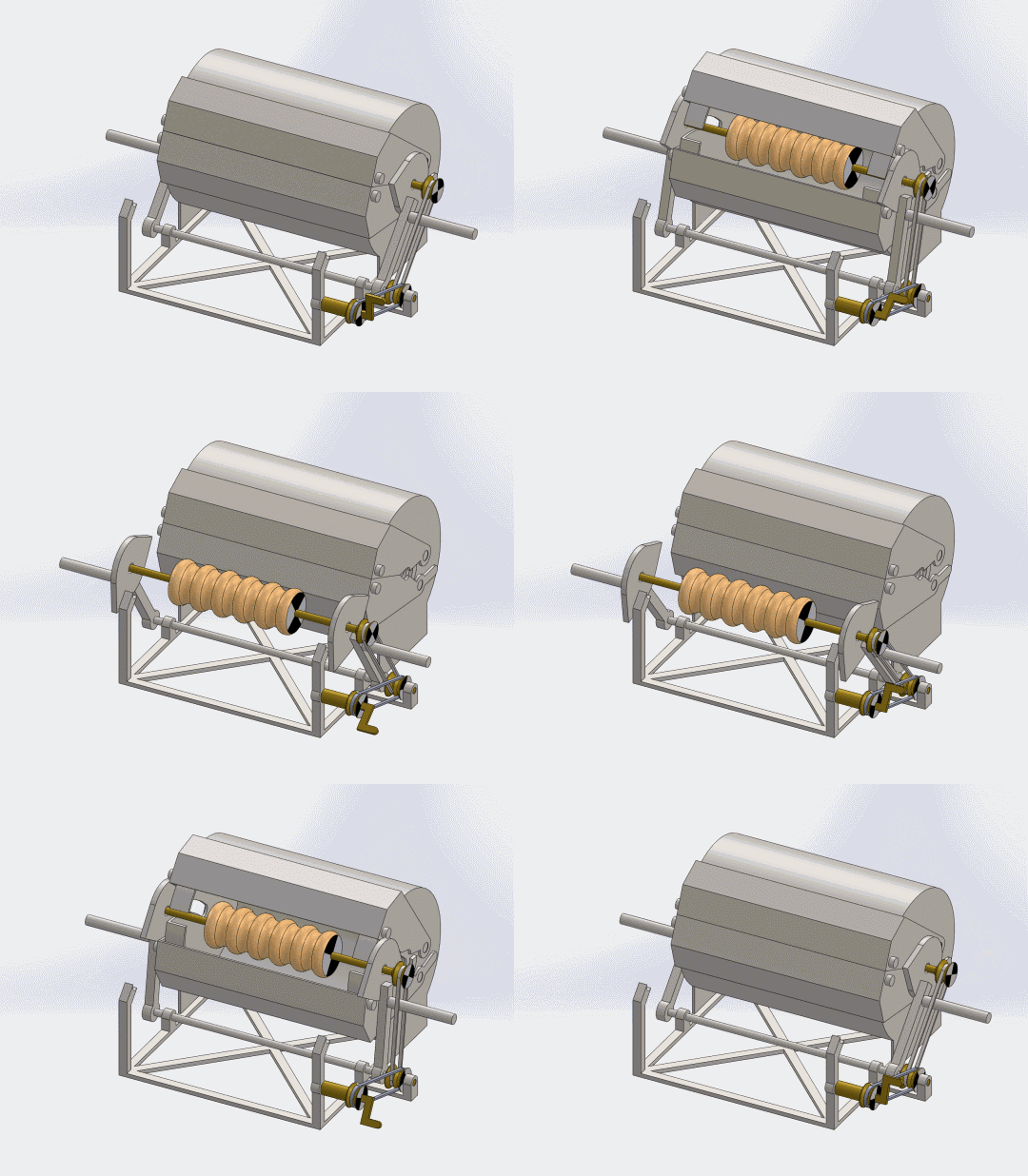
New cake machine .gif

Here is an updated version of the digital cake machine from earlier. Enjoy!
Technical details: It's a 1:6 scale design that I'm printing on my Průša i3 printer. The pulleys (gold) are connected by rubber bands, so by turning that crank you can spin the cake whether it's inside or out of the oven. The long handlebars let the user slide the cake in or out. The cams on either side of the cake (the things that look like Darth Vader's helmet) hit the little nubs on the oven doors, forcing them open only when necessary—thus minimizing heat loss.

Saturday, February 7, 2015

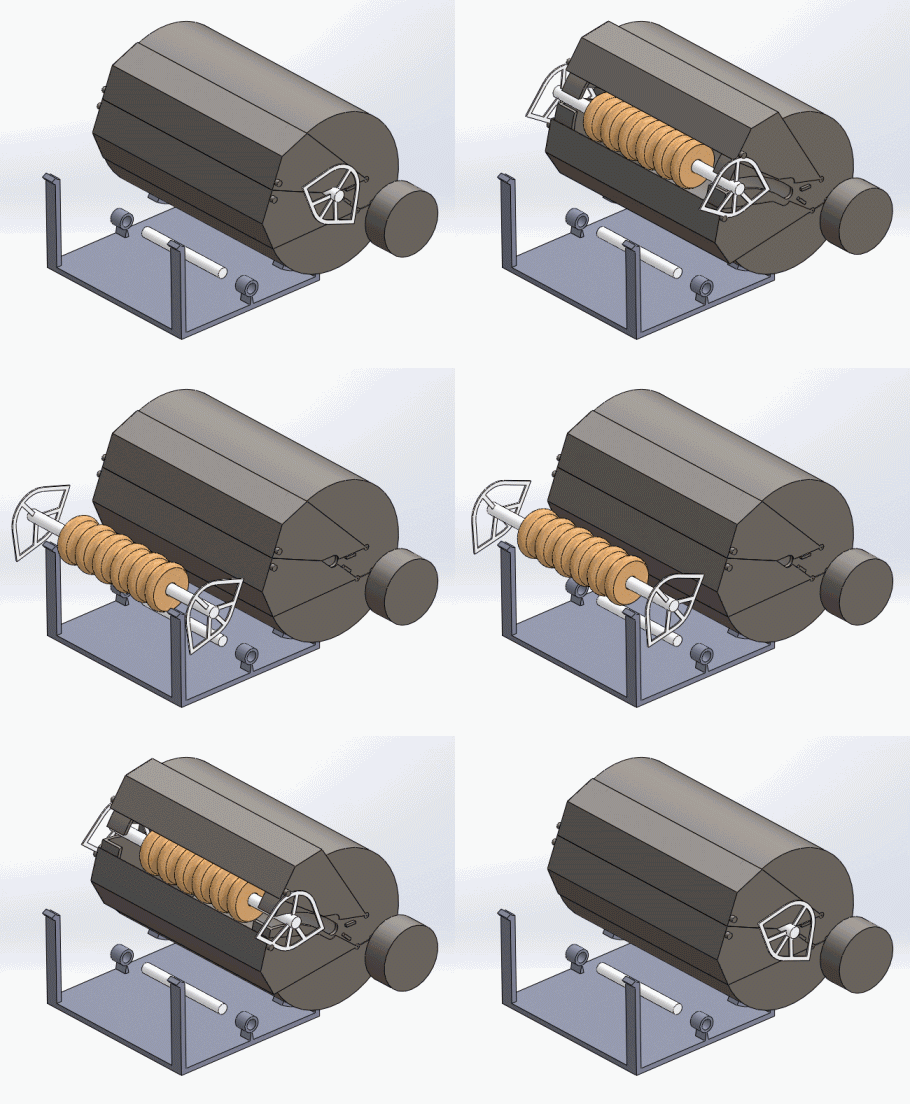
I could have sworn I posted this gif

I made a fun cake machine gif and then forgot to post it?? What a terrible oversight.

OM NOM NOM

Friday, February 25, 2011

Time to right some wrongs

It's the year 2011. Let's do some cake blogging.

On June 13, 2010, I promised I would put up a translation of the Russian-language news video. What's more, I promised I would do in under 24 hours. Welp, it's been eight and a half months, might as well post a translation now.

Here's the gist. The story starts talking about the history of the cake. Some king spilled sugar onto some bread (which was on a rotisserie for some reason?). That...that's not a very good history, guys. Whatever. It's traditionally a wedding cake, and this one is over 50 kilograms. It took over five hours of constant turning and batter-pouring to make. It's got cognac in it for flavoring. 1200 eggs went into the batter. It's 12 cm larger than their last cake, although it's not specified if that means radius, diameter, or axial length.

Next order of business: on May 27, 2008, I promised further developments on the antique cake machine thing. Well, here's what I remember. It works in a standard kitchen oven, with the door open and the broiler on. The set is cast-iron, with two stands and a spit with hand crank. One of the stands goes in the oven, and the other goes with the batter. Rest the spit on the not-in-the-oven stand. Put some batter on the spit, put the spit on the stand in the oven, and start turning. Move spit back to the other stand, repeat process. It's very messy, and I bet the open oven with broiler on is miserable.

BAM! I GET THINGS DONE! ...Kind of.

Thursday, August 12, 2010

Sweet Tree Bakery, London, England

I spent a big part of Saturday, July 24 making my way from Charlton (way down south) to Wood Green (way the crap up north). Why? Sweet Tree Bakery, baby! Possibly the only spitcakery in the British Isles, it makes both baumkuchen and šakotis! How could I miss this?

Sweet Tree Bakery is hardcore. They cultivate natural yeast for about half of their breads, utilizing all sorts of tasty fruits and grains to make every loaf special. Two Bavarian ladies are in charge of the breads and jams, and a Japanese man bakes the pastries, including the spitcakes. None of them are native Anglophones; they all speak with incredibly thick accents, and they were unable to understand my dialect (American plus difficulty with liquids). This led to a great game of telephone: I would ask a question in my dialect, then another customer (a gentleman in a Mr. Bungle t-shirt, I will refer to him as Mr. Bungle) would repeat the question in one of the London dialects, then one of the bakers would answer and I would have to spend about twenty seconds analyzing their speech for comprehension. But I digress. How were the spitcakes?

Well, I only had baumkuchen. It's true that STB bakes both varieties, but only one kind per day. I happened to arrive on a baumkuchen day. If I had gone there on Friday, or if I came back again on Sunday, I could have gotten šakotis.


Was it good? Oh yes. Oh. Yes. The cake itself was just a little sweet, the icing mellow, the texture out of this world. I thought it got better with every bite. That baker puts all his effort into making the best product possible, and it shows, man.

After some more fumbling with words and having Mr. Bungle act as interpreter, they agreed to let me into the kitchen and see the cake machine as long as I didn't touch anything. Oh, joy unbounded!


There it is, in all its glory. The Cake Machine. An angelic chorus is singing. This machine was manufactured by Schlee GmbH. It's electric, as you can see, and relies on three-phase power, presumably for the large motor.

Do you see that huge fan behind the oven? It's not the only one. There was an array of fans, I think five, along that wall, spinning their little hearts out. And it was still so damn hot in that room! Definitely over 40°C (100°F).

So now I'm a little worried about a cake machine in a van. For one thing, three-phase is out of the question. And unless I've got all the doors thrown open, I might cook myself in there, alongside the cake. Vamos a ver.

Thursday, August 5, 2010

My heating element will be electric.

Heating elements: electric.

Photos of my cake adventure in England will follow. For now, check out this diagram I made.

Friday, June 25, 2010

Return to the Baby George Rotisserie

I've been talking about cake on this blog since April 2008. Since then, I think I've made it clear that I'm not very good at research, design, construction, baking, or blogging. But I'm always making progress, no matter how slight or how slow!

There's so much information out there. I just get bothered when I realize that I could have theoretically avoided pitfalls years ago with only a modicum of effort. And this happens often! I could have saved myself a lot of trouble if I had just seen the following site when I began.

Baumkuchen USA is the mail-order business of some dude named Klaus in Piqua, Ohio. He ships baumkuchen that he bakes himself "in a custom built rotisserie." But look at the pictures on his site:


That is clearly a Ronco Showtime Rotisserie! I have no idea what customizations there are in his machine (if any), but it looks like he's baking baumkuchen in a perfectly normal rotisserie. I think this means I could have potentially been baking baumkuchen since Cake Weekend in December 2008.

As always, I'm making up for lost time. I gave the George Foreman rotisserie a thorough cleaning, inside and out, then pulled off some spikes on the spit itself to make it more cake-friendly. More to follow! Stay tuned.

Wednesday, June 2, 2010

Cake machine heating elements

I still want to build a cake machine, it's true. The major impetus to actually doing so is that I don't know the best way to provide heat. My options are electric, gas, and wood. I wish I could consult some heating experts, but I don't know any. I tried wandering into a grill-and-fireplace supply store this afternoon, but the clerks were not helpful at all. Tragisch.

ELECTRIC HEATING
Electric heating has been recommended by some people. My small-scale tests with electric heaters suggested that they can probably get a full-size oven up to the operating temperature range. Unfortunately, I have no idea what to do from here. There are so many kinds of electric heaters and I don't know where to get ones that are the appropriate size and shape for my rather specific application! Some of the Schlee GmbH machines use infrared bulbs, so I think I would do likewise. But I don't know exactly what I'm looking for in a bulb, so I could end up throwing my money away.

GAS HEATING
Gas is quicker to start than electric heating. I could stop it and restart it when I need to open the oven and apply batter. But I'm more likely to blow myself up. The Schlee machines that don't use electric use something called "infrared gas heating" and I can't find any good resources on this. There are plenty of resources on how to make pipe burners that I could use, but again, I run the risk of blowing myself up.

WOOD OR CHARCOAL HEATING
Wood fires are the traditional heat source for baumkuchen. But I'm worried that it might compromise the taste! I do not know if this is a valid concern. This is probably also a lot easier to get started with now, and I could eventually graduate to a gas or electric heater later.

Now, onto the issue of getting a metal drum for my oven!

Sunday, December 28, 2008

Cake Weekend Day 1

THIS WEEKEND IS CAKE WEEKEND

THE ORIGINAL DECISION WAS THAT BY THE END OF THIS WEEKEND THERE WOULD BE A CAKE MACHINE BUILT

MUCH ENTHUSIASM IS NEEDED

I AM SO ENTHUSIASTIC I CANNOT TURN OFF CAPSLOCK

Okay, enough of that. Here's the documentation.

Day 1: Saturday

Saturday began with Raymond driving over with a George Foreman desktop rotisserie. We had determined the night prior that finishing the full-size cake oven would definitively be impossible, as we had yet to find a satisfying balance of light weight, low cost, and sufficient strength. We settled for making a smaller oven using a readily available rotisserie assembly—as a prototype, mind you, and nothing else—and perhaps a tiny cake.


It looks like a cheap temperature sensor, but hey, it goes all the way to 300°C (571°F) which is great for an application where the optimum temperature is 240-260°C (464-500°F). Oh geez it's displaying Fahrenheit whoops how did that happen.


Tinsnips! This is to make a hole for the temperature sensor.


Pieces folded back, hole punched with an awl.


Hmmm...


Well, let's see what's inside.


Oh hey look at that, the oven's reassembled! It's all ready to go and we can see at what temperature the rotisserie peaks. If we can easily get it up to 250°C, we are good!


Oh geez it's still reading Fahrenheit.


The oven peaked around 207°C (405°F), which is NOT YET HOT ENOUGH.


Well, if we can fit another heating element in there, it should get to 250°C just fine, right? Raymond shows me that bending a heating element (such as the one in the bottom right corner of this picture) shorts it out and renders it useless. My bad. I guess we need something more compact...


The solution is more George Foreman! $5 and a quick trip down the block lands us the Lean Mean Something Something.


Here it's been gutted and the heating elements extracted.


These compact little guys will be mounted, one on each side wall of the oven. Did that make sense? I mean here:


...and here:


To fasten them on, we create little aluminium brackets which will be screwed onto the sides shown above.


Side view of bracket.


At this point, it was kind of late and time for Raymond to depart. And neither of us will have much time for cake weekend on Sunday, so it looks like cake weekend is a bust. Well, significant progress was made, I guess. Good thing I still have half a store-bought 'kuchen in the fridge.


Partial success!

Things to remember for next time
  • Raymond. Dude. Check your tyre pressure.

  • That's about it, really. The rest of this is more or less flyin' blind with no preparations.

Tuesday, November 25, 2008

What the engineering profs have to say

Here's the feedback I've gotten recently:

  • It must be electric. Amateur gas pipes mean propane will accumulate at the top of the box, which is way bad.

  • Ceramic bulbs for heating and fireclay for insulation. YES.

  • Depending on the motors being used, it may be best to connect the motor to the spit with a bike chain? It is not difficult to cut sprockets for those so speed control should be much simpler this way. Watch your fingers.

  • One of the traditional recipes I had been looking at (I should make a post for traditional recipes later) is extremely bitter tasting and should not be trusted at all.

  • With fireclay, weight will be an issue, especially with mobility.

  • Safety features! Digital temperature sensors are apparently pretty simple to implement? Also there absolutely must be emergency vents if the oven area gets too hot or any of the structural integrity is compromised.

  • Make many more drafts and don't get too attached to any of them.

  • CAAAAAAAAAAAAAAAAAAAAAAAAKE

Wednesday, August 13, 2008

Today!

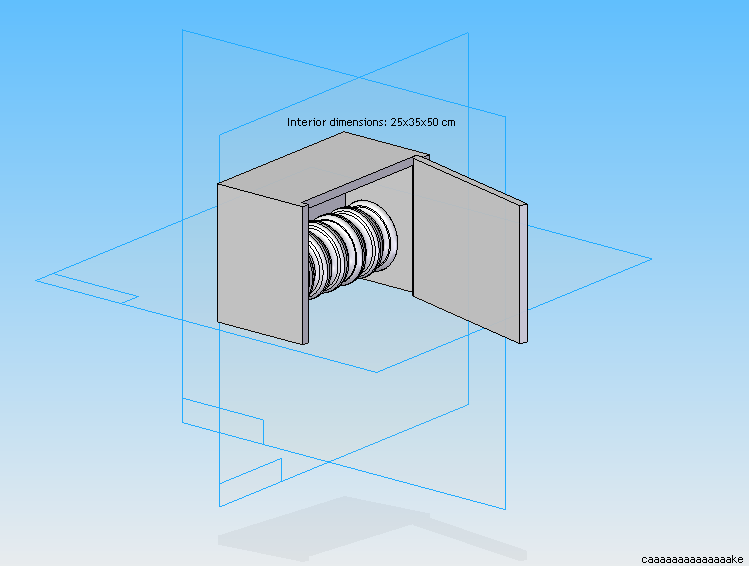
Today I converted two people to the Cult of the Rotisserie Cake, or Drehspießkuchenkult, and drafted a new image. It has no bottom, so batter drips fall and be caught and reused. It's made of refractory cement, electrically heated (optimally), and has extra space on the top to accommodate a ladle full of batter. Refractory cement definitely seems like the best solution. Way better than steel. Though a steel skin on the outside is good.

Mmm, Kultkuchen.

Friday, June 13, 2008

Genuine progress!

So I got and dismantled a camping stove. Now I have a variable propane regulator and a decent burner! Unfortunately, it's only about 16 inches long, so it needs a smaller case. I'll look for a small metal drum.

Now I have a good idea for spinning the spit! Imagine two rubber wheels on each end, outside of the oven itself, spinning slowly in the same direction. The wooden spit can rest on top of them and spin at a similar rate. This way I don't have to worry about hooking gears into the spit itself; all the chains and necessary things are attached to the wheel rig. However, I'd have to make two wheel rigs, one for the oven and one for applying batter.

Thursday, April 24, 2008

Rough drafts

Every time I make a new draft, I look at my old ones and think, "Holy hell, that's stupid and way too convoluted." Each new version is simpler than the last, but I still haven't settled on one to make.


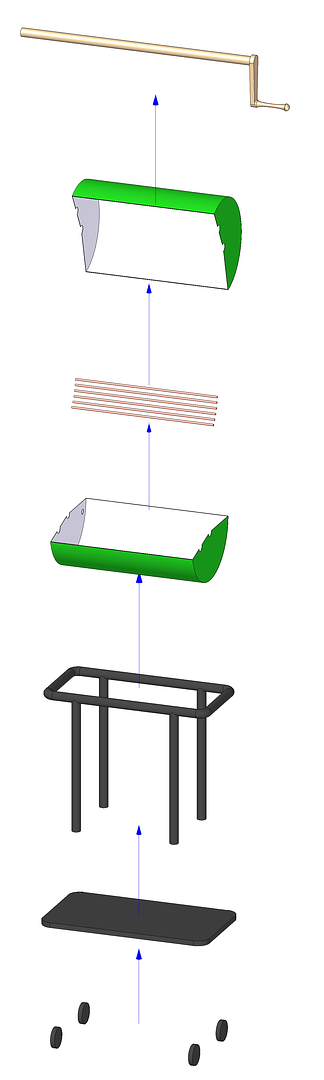
Version 1 I made as similar as possible in appearance to the Japanese machines I saw on YouTube. I envisioned a sliced-open metal drum with the gear motor and rotisserie on that axle. The pipe in the back is a gas starter pipe like those in fireplaces. Huh. I forgot that I had originally wanted gas heat.


The next version was very similar, but only moved on one axis. In retrospect, this is really worse than the first draft, because it has to slide and makes more moving parts. There's no gas pipe shown, but I'm sure I was still thinking gas heat at this stage.

Then, somehow, I got obsessed with this shape:


I started making plans for a hollow trapezoidal prism with electric heaters on the inside of the three rectangular faces. In smaller models, this could be picked up and placed over the rotisserie, which would mean no axle needed.


This was also a dumb move, just because the shape is so awful. Now, my current line of thinking is a rectangular prism and propane burner.


(Not shown: Rails to hold the rotisserie bar in place) One day, that will surely look hella stupid too.