Showing posts with label baumkuchen. Show all posts

Saturday, September 26, 2015

FINALLY, rotisserie cake!

I did it. I baked a cake on a rotisserie.

Let me cut right to the chase: why hadn't I done this yet? I don't have a very good reason. Many many years ago, I thought I'd have to mod a kitchen rotisserie to put out more heat, but Klaus Taesler showed me that wasn't the case. Since then, it's just been my hesitation and equivocation. It's hard to justify buying bulky kitchen appliances that rarely get used (what Alton Brown calls "unitaskers"). Then, not too long ago, I realized, if there's anyone who can justify buying a rotisserie for cake, it would be me!

A little time on Craigslist later, and I had a George Jr. rotisserie! This one's not the same as the Baby George rotisserie I obtained many years ago. This George Jr. is larger and gets hotter than the Baby George, both good things. Besides, Baby George is thousands of miles away in my parents' garage.

All told, the process wasn't as tough as I'd thought, and the result was great! I used the portions from retired engineer Wayne Schmidt's page. A bit embarrassing to publish a recipe in imperial units, but here we go:

INGREDIENTS (in chronological order)

  • 1.5 sticks (12 tbsp) butter, softened
  • 3/4 cup granulated sugar
  • 10 egg yolks
  • 1 shot brandy (I used apple brandy, Klaus Taesler uses cherry brandy)
  • 1 teaspoon vanilla
  • 1/4 teaspoon salt
  • 1 cup all-purpose flour
  • 1/2 cup cornstarch
  • 10 egg whites
  • 1/4 cup granulated sugar

THE PROCESS

  1. In a large bowl, cream the butter and 3/4 cup sugar.
  2. With mixers on low, add egg yolks one or two at a time.
  3. Add brandy, vanilla, and salt.
  4. Sift in flour and cornstarch until uniform.
  5. Wash your mixing apparatus. We're gonna make a meringue, so we have to keep all the oils away.
  6. In a medium or large bowl, beat the egg whites with mixers on high. Beat until the whites have roughly doubled in size.
  7. Add the 1/4 cup sugar and continue to beat until you reach medium-to-stiff peaks.
  8. Fold the meringue into the other ingredients in 3 or 4 stages. Fold just until the mix is homogeneous.
  9. Wrap the baumtüber in foil. If desired, bind with butcher's twine as if it were a porchetta.
  10. Turn on the rotisserie and let the baumtüber come to temperature.
  11. MAKE THE CAAAAAAKE

As you've probably gathered, I live-tweeted the whole process, which was fun. Each layer took 3-6 minutes, depending on how distracted I got. Some layers got browner, others did not. As a result, the layering is irregular and very subtle. No tree-rings.

But how did it taste? In a word: delightful. The texture of the layers stands out as the most noticeable feature in your mouth. The taste is pound-cakey but less sweet (again, perfect for pairing with coffee, tea, chocolate, jam, milk, &c., &c...). But it is quite dry! This is something I noticed in Klaus' counter-top-rotisserie cake as well. Cooking the layers at a lower temperature means they dry out more. I think the brandy also contributed to the dryness. Time to experiment and find out!

Finally, please enjoy a video of me pouring batter while listening to DJ Robert Drake on WXPN:

Saturday, July 18, 2015

The Very First Tree Cake

I've got a new recipe for you! Well, an old recipe. An old, old, old recipe. This is from 1582, written by Susanna Harsdörfer of Nuremberg. Katherine Barich of the "Cooking Rumpolt" Yahoo! group did a word-for-word translation that I tried modernizing. She also has a great set of medieval-baumkuchen-related thoughts, a lot of which came in handy during my current studies of Fritz Hahn. Anyway, the recipe!

To bake a cake on a spit

Beat 14-16 eggs in a pot. Add 1 maß [about 1.5 L] of thick milk [i.e. cream]. Next, take a scoop of wheat flour and add some ginger. Take a knobbed spit, crush ginger on it, then dust evenly with flour. In the pot add crushed mace and (if you wish) salt, pepper, and more ginger. Make the batter as thick as for milk toast [e.g. gulden schnitten]. Take the spit and put it next to the fire. Leave it there for half an hour, to ensure it is hot enough. Smear it with lard once or twice, being careful not to let the spit cool. To dribble the batter on, turn the spit and, with an iron spoon, pour the batter liberally onto the spit. Turn continually for a while, until there is a bit of a crust, then pour more batter on. Move the spoon carefully back and forth so the cake remains cylindrical. When the pot is almost empty, pour a bit more batter on the prongs, then bake the cake for 2 more hours until it is roasted through. When it has almost finished, baste with butter so it will be soft and succulent. Sprinkle sugar on it and serve.
And there's lots more details on my website!

Sunday, June 28, 2015

Cake in Japan

The Wall Street Journal did a weird interactive thing last year, marking the centennial of the start of World War I by exploring its lasting effects. Most of the videos were serious and somber, but there were a few lighthearted puff pieces. One such piece: Cake in Japan. Enjoy!

NOTE: the dubbed voice does not pronounce "baumkuchen" correctly, don't believe the voice!

Friday, June 12, 2015

Mimi Sheraton's article is back online

Mimi Sheraton wrote an article for The New Yorker back in '09. It was paywall-blocked for a while, but it's free for all now. Check it out!.

I have one big problem with this online version! It is missing the delightful page-two photo by Hans Gissinger! So naturally I had to dig through my Baumkuchen Journalism Briefcase (yup, I have a Baumkuchen Journalism Briefcase!) and scan it in. Here you go!

Saturday, June 6, 2015

May, 2015: Two Cakes for the Record Books

I've written about a couple big tree cakes before ([1], [2]), and often wondered if there's a governing body for claimants to the title of "largest tree cake." Well, according to various Lithuanian news sources, there may be a definitive champion, as of May 30 this year.

Do you see that mother of all cakes? It's 3.7 meters long and weighs 86 kilograms (not including the rotisserie)! Lrytas.lt reports that the batter was made with 49 kg sugar, 63 kg flour, 43 kg of various lipids, and 1700 eggs. Seventeen hundred eggs.

That same article reports that the bakers actually made TWO mega-šakočių. To qualify for the Guinness Book of World Records, the šakotis had to be cut up and eaten. But the Šakotis Museum wanted it as a trophy, too! So, naturally, that meant baking another 3.7-meter cake, and magically resisting the temptation to eat it.

So, that cake will soon show up as the Guinness Book's largest tree cake. But what about the longest tree cake? That separate record goes to the Japanese village of Chizuken. On May 10th this year, 880 volunteers prepared a baumkuchen that was 16.480 meters long. That's three giraffes, plus a guinea pig. They had originally been building a 20.327-meter cake, but part of it sheared off—a common baumkuchen disaster. Still, it was enough to break the previous record (14.654 meters, also made in Chizuken). And, like one of the giant šakotis from Lithuania, it all got eaten by volunteers. Tastes like victory.

Tuesday, August 19, 2014

What's new at Glaze?

Since my May tour of Glaze Baum Cakes, the team has pulled off a successful opening and merger with the trendy Japanese restaurant, Sasa. Amanda and Zach are still running the dessert show, and despite the cramped kitchen space they are working wonders. Seasonal flavors right now include more varied citrus, and they are bracing themselves for autumn and the inevitable rush on pumpkin spice baum cakes.

Pastry experimentation continues to pay off, too! During my May visit, the bakers lamented that the matcha baum cake had such a high failure rate, shearing apart with little or no warning. After diagnosing that the matcha powder was interfering with the whipped egg whites' ability to keep the cake solid, they began to tweak. Adding more egg whites affected the flavor too heavily. Putting the whites in un-whipped kept the cake from collapsing, but it ruined the smooth texture (effectively turning the batter into sandkuchen batter). Eventually they found a ratio of some whipped egg whites and some non-whipped whites that boosted their cake output and preserved the texture we've come to know and love! Is there a Fields Medal for cake science?

Aside: Sasa offers shredded mountain yam as a side dish. Fans of the literary genius Ryūnosuke Akutagawa may want to check it out, since this non-Newtonian pintxo is the crux of his 1916 short story, "Yam Gruel".

Thursday, July 31, 2014

NYC is a tree cake wasteland

I'm surprised I'm writing this: it's a negative review of a baumkuchen shoppe!

I can't speak authoritatively about turnover rate for tree cake bakeries. However, I can say that last year I identified a baumkuchen bakery and a kürtőskalács bakery in New York City, and both have shut down. So what was left for me to visit last week? Well, Google turned up two places that claimed to do a higher-end assembly-line cake product. Supermarket style.

AN ASIDE: SUPERMARKET BAUMKUCHEN
There are actually lots and lots of places to get baumkuchen in the United States and other nations. Japanese grocery stores sell them all over the place! You can go out and buy some. You should go out and buy some! But always remember: it is nothing like the real deal! Supermarket cakes are made to have a long shelf life, and they use preservatives and emulsifiers that noticeably alter the flavor and texture. In my opinion, the supermarket flavor is usually just okay, and the texture is always a little pathetic. So that's why I don't talk about them that often on this blog anymore.
END OF ASIDE

It was very disarming to realize that the only readily available tree cakes in NYC are made in East Asia and shipped here in vacuum-sealed bags with little desiccant packets. But like I said, two places advertised cakes made in this method but promised they were of superior quality.

PLACE NUMBER ONE: MINAMOTO KITCHOAN
BAD BAD BAD. Minamoto Kitchoan is a purveyor of high-end Japanese sweets with a luxury storefront near 30 Rock, in Manhattan. They offer two varieties of baumkuchen (plain and matcha) with an eye-popping price tag: $27 for a 300g cake. I bought the matcha flavor. It was, in a word, atrocious. The ingredients listed are identical to supermarket cakes—emulsifiers, preservatives, artificial dyes, artificial flavors. The texturing agents in the batter mean there's no satisfying distinction between layers; what a waste! It was way too sweet and had the mouthfeel of neon green lard. Don't forget, it was also the most expensive tree cake I've bought so far. Until they change their recipe, STAY AWAY.

PLACE NUMBER TWO: PARIS BAGUETTE
This one was actually superior to supermarket cakes! Paris Baguette is a Korean chain of pastry shops, and their cakes are baked in Korea. In that sense it was a first for me. I have to say, the plain Paris Baguette baumkuchen was pretty good for a pastry that crossed ten time zones to reach me. The texture was closer to fresh-baked, with good layer definition! It wasn't sickly sweet, and paired well with a cup of tea. Was it worth the $15? Perhaps...

Here's hoping the NYC tree-cake scene gets better and better!

Tuesday, May 27, 2014

Behind the Scenes at Glaze Baum Cakes - Denver, CO

I'm thrilled to write another piece about a rotisserie cake bakery here in the United States! It has been far, far too long. What's more, I may no longer need the phrase "rotisserie cake," since Glaze Baum Cakes has come up with a short, snappy phrase to describe cakes baked on a spinning axle. Baum Cake. What a nice phrase; more inclusive than "baumkuchen" (which is already a well-established referent for one very specific cake), more appetizing than "spitcake," and less of a mouthful than "rotisserie cake."

Speaking of mouthfuls, the Glaze team provided a comprehensive tasting menu for the occasion of my arrival. Between my warm reception here and at Baumkuchen USA headquarters, I'm convinced that "professional cake blogger" is the best job imaginable. Heather Alcott, the head of Glaze, is busy preparing for an official opening on June 15, but agreed to open the bakery's doors for me and my friend Susanna (a tree cake neophyte). Going inside, Heather introduced us to her pastry chef team, saying, "This guy is a baumkuchen blogger!" with disarming enthusiasm. Maybe I should get business cards with that title. But I digress.


Here's me, giddy next to the oven.

Glaze is an awesome addition to the tree cake scene. Their oven, the "Red Dragon," is a sleek multi-rotisserie marvel from Fuji Shokai, which incidentally was the first company I queried for cake machine pricing six years ago. It's the only Japanese cake machine in the United States. In fact, it's the only Japanese cake machine outside East Asia! This means Glaze, willingly or non, must be an ambassador, representing Japanese-inspired tree cakes for the whole Western Hemisphere. Don't worry, they sure do rise to the occasion. Patissiers Amanda and Zach were privately tutored for weeks by a baumkuchen artisan from the Japanese pastry élite, to round out their pastry school credentials.

The Glaze bakers show an obsessive attention to detail and to the quality of their ingredients. Granted, a certain level of obsession is necessary to bake a tree cake—to say nothing of running a tree cake business—but I was still surprised by every detail the bakers related. I assumed one of their biggest challenges would be adapting existing recipes for Denver altitude; no, they said, that's just a small part of the process of testing scores and scores of recipe variations. They go to amazing lengths to find just the right taste and texture.

So, how did the tasting event go?

Here's the array of cake flavors, mid-way through tasting. The bicolor wedges with a smooth surface are "Duo Baum Cakes," pairing original-style batter with chocolate or matcha flavors. These cakes, the Baum Cakes and Duo Baums, have the most seductive texture. The matcha and chocolate cakes are flawless; they really demonstrate the effectiveness of the bakers' perfectionism. That said, I worry that the original style suffers when presented solo. The very mild flavor is, by design, a good complement for tea, coffee, or the other half of a Duo Baum. But alone, it feels too dull to play well with the luscious texture. It's like having a Montblanc fountain pen but only using it for tic-tac-toe. Actually, looking back at my notes, The plain-style cakes I tried in the store had rum and fruit notes present, but I couldn't detect anything of the sort in the one I took home that night. Perhaps I am trying to review inconsistent pastry? The upshot here is that I support flavor in my tree cakes, and "inconsistent pastry" would be a great name for a rock band.

But there are so many great things about Glaze! Let's talk about those! Let's talk about the Mount Baums! Yessss, the Mount Baums. Their direct predecessor is the cake made by Nenrinya in Japan, but there's a clear connection to šakotis. The Mount Baums are thicker than the šakotis and gâteaux à la broche of my previous encounters, though I remain convinced that not all of them are thin (for example, the ones at Sweet Tree). The inside of the Mount Baum is moist, with uneven layers, but it's the kind of unevenness that is the product of meticulous care from the bakers. Magically, this interior moistness is preserved, even though the outer layers transition to a drier, crunchier, cookie-like consistency. I suspect this is because they don't do the key step in šakotis-baking, where they spin the cake faster and faster with each layer. The shifting textures create a little puzzle for the jaws to ponder and delight over, while the tastebuds savor the sweet icing and the mellow cake flavors. They blend in a way that feels more complex and satisfying than in any of the rustic gâteaux or thin šakotis. I'm not surprised that it took such a dedicated team to pull off these amazing cakes.

Aside: I got way, way excited for one Mount Baum's Cointreau glaze, but then again, I'm the person who puts Cointreau in chocolate chip cookies, so that reaction was pretty much a given.

There are even more cool cakes from the Glaze staff experiments. On the menu are baked apples and pears, tree cake style. They use a special spit with retractable hooks to secure the fruits before layering them with the exquisite batters. I can't imagine how long it took to figure out the settings to get a perfectly baked fruit in there without overdoing the cake layers. I mentioned Trayne Roste as a possible alternative for when suitable fresh fruits aren't around. Think they'll try it out?

As for other off-the-menu experimentation, Amanda told me about their Super Bowl chimney cake tests, wrapping pretzel dough and sending that through the Red Dragon on a low heat setting. I have got to try that myself, it sounds amazing! But I can see why it stayed off-menu, since it veers a bit off course for the Japanese café theme.

Aside again: Heather says a great number of their online orders come from Japanese immigrants around the country. That's a pretty solid metric for success, eh?

Glaze reopens June 15. It has joined forces with a local izakaya, and will be serving up drinks, Japanese bar food, and small plates in addition to the phenomenal cakes and macarons. Please check it out!

Thursday, May 15, 2014

NPR story about Glaze Baum Cakes in Denver

I'm so glad to hear Glaze Baum Cakes is doing so well! There's a wonderful NPR story up now, talking about Baumkuchen with the Glaze family. Maybe I should get back into Cake Reporting, and get myself on the news...

Tuesday, May 7, 2013

THREE CAKES, TWO DAYS, PART THREE: Taste Testing

Soon we arrived in North Carolina to try the still-fresh cakes with Theo, my good buddy and host. It was time to give the cakes a proper and thorough tasting!


Okay, so the video isn't really the "proper and thorough tasting," more of a precursor. Good thing I took detailed notes, because I'm writing this up like ten months after the fact. The whole affair drove home the point that there is an impressive variety possible in rotisserie cake-baking. Artisanal one-off baumkuchens and vacuum-sealed Japanese-grocery-store baumkuchens are incomparable, it's true. But how do you compare baumkuchen and šakotis and gâteau à la broche?

Well, let's start by fawning over the two baumkuchens that were on that table. Herr Taesler's cake was a treat for its nuanced flavoring. It was not as sweet as cakes often are, which made room for subtle flavors to come through. Rum, vanilla, almond, butter, and fruit notes played in harmony as we chewed and pontificated. The Lutz baumkuchen, meanwhile, stood out for its luxurious texture. The flavor was fairly uniform, sweet and rum-like, but the cake was moist and texturally decadent in a way that only layer-by-layer cake baking can achieve.

This was my first proper šakotis, too! I was not expecting it to be so thin! As a result it was dry and crunchy. I'm not sure how typical that thinness is. The Pyrenean gâteaux I saw varied greatly in thickness, so I'm hesitant to judge all šakotis by this one's dimensions. The flavor was eggy, like a cookie that would pair well with a strong coffee on a winter morning. Mmmm.

All in all, a very good day!

Monday, May 6, 2013

There's a baumkuchen bakery in Denver!

A new baumkuchen bakery is on the scene! It's called Glaze Baum Cakes. I wonder what was the logic behind the partial Anglicization of the name. Maybe I'll have to drive out and ask in person...

Monday, April 22, 2013

Excellent Toaster Oven Baumkuchen from Japan

Before I finish my story of the three cakes, here's a two-part video of a Japanese DIY job featuring an excellent overdramatic musical selection!


Friday, April 5, 2013

THREE CAKES, TWO DAYS, PART TWO: Piqua, Ohio


I rather like the candidness in this photo.


I've mentioned Herr Taesler before. Last July I actually got to meet him! I think we were both equally excited about the encounter, because it meant a rare opportunity to discuss an odd interest in person.

The tour of baumkuchen Mecca began, of course, in the kitchen. Hr. Taesler doesn't use a Ronco Rotisserie, as I first supposed--it's a similar product, but reaches a higher top temperature. Klaus has special modifications for his tapered baumkuchen forms (below, you can see one artfully bound in string, a traditional tying method that helps the first layers adhere). He described the heat from the near-constantly open oven as physically taxing, especially in the summer; fortunately, most of his orders come near Christmastime. There's a lot of finessing and tweaking to make sure the cakes turn out superbly. He gave me a lot of practical advice: The first layers' adhesion is critical. There's nothing worse than seeing a nearly-done cake fall apart in the oven. As soon as you can, wrap the fully-baked cake in plastic wrap so it stays moist while cooling. Try making multiple batters with different flavorings and alternate which one you use on each layer.

Everything about the experience gave a mystical sense of passing on a dying craft.


We continued talking over tea. The Taeslers shared with us some hearty homemade black bread, and showed off an antique Swiss crossbow so big that it took two soldiers to load it. Naturally, we tried some of his baumkuchen here too. The fresh cream and chocolate ganache filling the center were heavenly, and the flavors that ring out in the cake itself were, to me, strong reminders of the vast differences between artisanal hand-made baumkuchen and automated robot baumkuchen. It was a terrific day.

The cakes themselves get a fuller analysis in the next post!


THREE CAKES, TWO DAYS, PART ONE: Chicago

Opportunities for spitcake tourism are few and far between, so three cakes in two days is something special. Maybe a record! Definitely a record for "hardest trip to explain to my roommates."

My last day in Chicago, at the height of summer, was my day to get spitcakes with my copilot (who is also named Sam). I knew that Chi-tonw was home to Lutz Café, up by Horner Park, and Racine in the Polish-Lithuanian southwest side.


The display of Lutz baumkuchen available to-go.


Racine šakotis/raguolis in its protective plastic wrap.


Lutz Café, which offers baumkuchen, is very much a restaurant and tea room. Racine is rather a specialty supermarket which happens to have šakotis (which they call raguolis, equally valid). Both places bake their cakes on-site, though only Lutz has the option of eating it there. Most are packaged up and sold just like a mass-produced confection. This seemed unjust to me, but I didn't have much time to dwell on it. Sam and I splurged on cakes, loaded them into a cooler, and early next morning set off for a little hamlet in Ohio, to meet a man who needs no introduction...

Monday, May 14, 2012

I am conflicted about posting this recipe

I don't really like the taste of black pepper. That said, Bravo TV posted this recipe, so I'm sharing it with you!
Black Pepper Baumkuchen
  • 200 grams butter
  • 150 grams sugar
  • 2 grams salt
  • 2 grams vanilla extract
  • Zest of 1 lemon
  • 1 teaspoon black pepper, ground
  • 80 grams yolks
  • 210 grams whites
  • 150 grams sugar
  • 175 grams cornstarch
  • 65 grams almond meal
  1. Cream 1st four ingredients, beat in yolks.
  2. Make meringue, fold in cornstarch.
  3. Fold in dry and meringue alternating.
Nice job, chef Morgan Wilson!

Thursday, August 12, 2010

Sweet Tree Bakery, London, England

I spent a big part of Saturday, July 24 making my way from Charlton (way down south) to Wood Green (way the crap up north). Why? Sweet Tree Bakery, baby! Possibly the only spitcakery in the British Isles, it makes both baumkuchen and šakotis! How could I miss this?

Sweet Tree Bakery is hardcore. They cultivate natural yeast for about half of their breads, utilizing all sorts of tasty fruits and grains to make every loaf special. Two Bavarian ladies are in charge of the breads and jams, and a Japanese man bakes the pastries, including the spitcakes. None of them are native Anglophones; they all speak with incredibly thick accents, and they were unable to understand my dialect (American plus difficulty with liquids). This led to a great game of telephone: I would ask a question in my dialect, then another customer (a gentleman in a Mr. Bungle t-shirt, I will refer to him as Mr. Bungle) would repeat the question in one of the London dialects, then one of the bakers would answer and I would have to spend about twenty seconds analyzing their speech for comprehension. But I digress. How were the spitcakes?

Well, I only had baumkuchen. It's true that STB bakes both varieties, but only one kind per day. I happened to arrive on a baumkuchen day. If I had gone there on Friday, or if I came back again on Sunday, I could have gotten šakotis.


Was it good? Oh yes. Oh. Yes. The cake itself was just a little sweet, the icing mellow, the texture out of this world. I thought it got better with every bite. That baker puts all his effort into making the best product possible, and it shows, man.

After some more fumbling with words and having Mr. Bungle act as interpreter, they agreed to let me into the kitchen and see the cake machine as long as I didn't touch anything. Oh, joy unbounded!


There it is, in all its glory. The Cake Machine. An angelic chorus is singing. This machine was manufactured by Schlee GmbH. It's electric, as you can see, and relies on three-phase power, presumably for the large motor.

Do you see that huge fan behind the oven? It's not the only one. There was an array of fans, I think five, along that wall, spinning their little hearts out. And it was still so damn hot in that room! Definitely over 40°C (100°F).

So now I'm a little worried about a cake machine in a van. For one thing, three-phase is out of the question. And unless I've got all the doors thrown open, I might cook myself in there, alongside the cake. Vamos a ver.

Friday, June 25, 2010

Return to the Baby George Rotisserie

I've been talking about cake on this blog since April 2008. Since then, I think I've made it clear that I'm not very good at research, design, construction, baking, or blogging. But I'm always making progress, no matter how slight or how slow!

There's so much information out there. I just get bothered when I realize that I could have theoretically avoided pitfalls years ago with only a modicum of effort. And this happens often! I could have saved myself a lot of trouble if I had just seen the following site when I began.

Baumkuchen USA is the mail-order business of some dude named Klaus in Piqua, Ohio. He ships baumkuchen that he bakes himself "in a custom built rotisserie." But look at the pictures on his site:


That is clearly a Ronco Showtime Rotisserie! I have no idea what customizations there are in his machine (if any), but it looks like he's baking baumkuchen in a perfectly normal rotisserie. I think this means I could have potentially been baking baumkuchen since Cake Weekend in December 2008.

As always, I'm making up for lost time. I gave the George Foreman rotisserie a thorough cleaning, inside and out, then pulled off some spikes on the spit itself to make it more cake-friendly. More to follow! Stay tuned.

Thursday, May 27, 2010

On Cake Box cake expiry

My family ate about 2/3 of that baumkuchen I bought in January. We stowed the remainder in an airtight container in our freezer. Now, four and a half months later, we've pulled it out to celebrate my return from another successful semester at school. It's still moist, still delicious, and it didn't give me food poisoning. I feel that it's reasonable to say that your Cake Box baumkuchen will keep in the freezer for at least 5 months!

I take no responsibility if you take this advice and become ill.

Tuesday, January 12, 2010

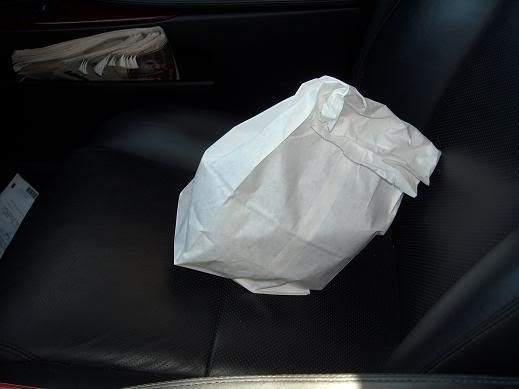
Why, what's this bag?


Why, it appears to be a cake!


An hours-old, hand-made baumkuchen from a generations-old recipe and a generations-old oven!


This photos are of the cake I got from the Cake Box, taken right after I left. I need to reiterate that it was way tastier than its machine-made Japanese counterparts.

Saturday, January 2, 2010

Returned from Cake Box

Cake Box is a fantastic place. A very European shop with very European service. I immediately purchased a large chunk of chocolate-glazed baumkuchen, then spent about twenty minutes just chatting with the proprietors. Chef Paul Gauweiler is probably the only Baumkuchen artisan within 2000 kilometers, and I got to chat with him and his wife/sous-chef! They were unabashedly excited to learn that there are youths who want to keep the traditional Baumkuchen-making methods alive.

Their baumkuchen oven, an 80 year old dual-gas-electric machine, sits in the corner of the shop, in plain view. They wouldn't let me take pictures, but it did look an awful lot like a 55-gallon metal drum slit lengthwise.

Anyway, the cake. It was much moister than the flatkuchen Eidolon and I made earlier, but the flavor was about the same (in other words, phenomenal). The layers were just a wee bit thinner than ours were, but still much larger and more uneven than the Japanese machine-made ones. Overall, it makes me think that I could make Baumkuchen if I really tried!