Showing posts with label chimney cakes. Show all posts

Sunday, August 2, 2015

The family tree

PREVIOUSLY, I talked about the rotisserie cake family. Today, it's all about the family tree!
I just posted my translation of a 1964 article (well, 75% of it). The author, Fritz Hahn, did copious research to track cakes on spits from ancient Greece to modern Europe, identifying five "generations":
  •  Generation I is the ancient Greek ὁβελίας, a very large bread baked for Dionysian celebrations some time before 600 B.C. When you want to bake a bread as large as possible, you can't use some dinky oven in a cramped kitchen. You've got to go big! Find a long tree trunk, wrap your bread dough around it, and make a huge fire. There's good evidence that the Bacchanal Romans continued this tradition for many centuries, spreading it to the north. After the collapse of the Roman empire, there are no more references to bread on a spit for nearly a millenium; it shows up in Daun, Germany, in 1466. Hahn suggests that this German bread is a direct descendant of the Roman bread, but I think it's pure coincidence. Convergent evolution, if you will.
  • In Generation II, the big German bread-on-a-spit gets shrunk and sweetened. Sugar was a rarity, so the yeast-dough cakes were seasoned with currants, honey, ginger, citrus peel, or other delights. The earliest attested recipe is from 1450. Modern helical chimney cakes (i.e. kürtőskalács and trdelník) are still considered Gen. II cakes in Hahn's taxonomy.
  • Generation III seems like a bit of a misstep. Previous versions were secured on the spit by winding a tight helix of dough. The Gen III cake is still yeast dough, but rolled out in a big rectangular sheet, then cinnamon-rolled onto the wooden form. To keep the cake on the roll, the chef has to bind it with string, or else it would get saggy and fall off. HOWEVER, the string also restricts how much the cake-roll expands wherever it is placed, which may have led to a pleasant smooth-ridged exterior like we see today.
  • Generation IV is the big shift from single-layer yeast-dough cakes to many-layer liquid-batter cakes! Hahn credits the new development to two things: the introduction of coffee (which fostered innovation wherever it went) and the 30 Years War (which occupied most of the employable men, and finally gave women access to the trade manuals and cookbooks that had long been men's secrets). The first two people to write Gen IV recipes were women! Susanna Harsdörffer, in 1582, and Maria Sophia Schellhammer, in 1692. Šakotis is a Gen IV cake. [EDIT: oops, in modern times it is usually made in the Gen V manner]
  • Generation V is what we know and love today. This version vastly improves texture by separating the eggs, beating the whites and folding them into the rest of the batter. This has the added benefit of making many thinner layers possible. Yes!
Another noteworthy point from the article: the name baumkuchen predates the Gen IV and V cakes (the only generations with the rings-of-a-tree feature). It must have been first named that because it was baked on a tree trunk.

Friday, June 26, 2015

1581-82 was a boom year for cake publishing

I've been doing lots of historical spitcake reading, and one particular find has got me in a tizzy. There is a Yahoo! group, still active no less, transcribing and translating all sorts of old cookbooks for this digital age! The main focus of the group is Marx Rumpolt's Ein new Kochbuch from 1581, which Wikipedia calls "the first textbook for professional chefs in training." This book is too early in spitcake development, so it doesn't feature the phrase baumkuchen, but it does give a recipe for Spieß kuchen (spit cake) and recommends serving it to nobility as the third (final) course of the first meal of the day.

The group leader, Ranvaig, gives the following translation:

Take warm milk and beat eggs with it / mix a dough with fair white flour / take little beer yeast and butter to it / let it stand a while behind the oven / that it rises / make it again into a ball / and salt it a little / then roll it out cleanly / throw black raisins over it. Take a Walger (roller) / that is warm / and rubbed with butter / and lay it on the dough / wrap the dough over / and tie it together with a twine / so it does not fall off / lay to the fire and turn slowly / like this will it roast cleanly. And when it becomes brown then take a brush / and put it into hot butter / and coat the cake with it / like this it will be a beautiful brown. And when it is roasted / so take it off the roller spit / and put into both holes with a clean cloth / that the heat remains / let it remain like this / until it is cool so give cold on a table / so it becomes tender and good. And one calls it Spiesskuchen.

As you can see, it's a chimney cake, not a tree cake. Supposedly, the first real tree cake is mentioned only one year later, in Nuremberg, by Susanna Harsdörfer. But that recipe, like I mentioned in the last post, is hand-written and I'm still working out the translation. However, now that I've discovered this DELIGHTFUL Yahoo! group, I think it'll go a little easier!

Transliteration and translation by Sharon Palmer aka Ranvaig Weaver, © 2013.

Tuesday, September 2, 2014

The rotisserie cake family!


Hello, can I be adopted by this family please?

I just learned about THIS WONDERFUL WEBSITE, which is primarily about chimney cake but embraces all the members of the cake-on-a-spit family. There's an insane amount of information here, and the documentation page has all the resources one could ever hope to acquire. This is wonderful, because I am busy populating my own website with very similar information. I feel one step closer to a proper communications network for rotisserie cake enthusiasts.

Saturday, March 12, 2011

Chimney Cake

Did I mention that I'm in Spain right now? I don't think I did. Anyway, that's where I am this semester, which opens some new cake-related doors.

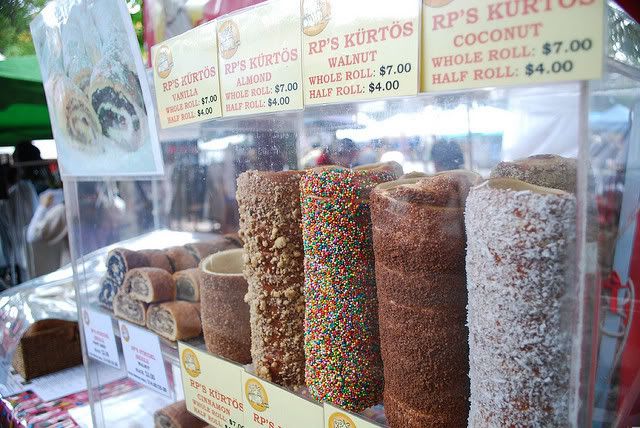
Well, in February I went to Budapest, home to its very own spitcake called kürtőskalács, or "chimney cake." It's quite unlike baumkuchen and šakotis! Instead of layers of batter, it's made by rolling out a long, thin strip of sweet dough (kürtőskalács is a yeast cake). This gets wound onto a conical form, so you get a nice tapered tube. The dough is dusted with sugar and stuck in a special kürtőskalács oven, which spins multiple individual cakes, each on its own spindle. The result is a sweet, dense, bready pastry with a thin crispy shell of tasty burnt sugar. When it's taken off of the conical form, the cake can stand upright, fragrant steam pouring out the top, leaving no doubt how it got its name. While still hot, there's the option of dusting the cake with a topping of your choice—traditionally, walnuts or more sugar, but other options include cocoa powder, cinnamon, dried coconut, or vanilla. Some places even make savory kürtőskalács, topping them with meats and cheeses and savory herbs and spices!

And it's cheap, too! In Budapest's Nyugati Pályaudvar, there's a shop that sells nothing but chimney cake at 380 forint (1.90 USD).


A modern kürtőskalács oven. [source]


A more traditional way of baking chimney cake. But not too traditional; observe the axle motors on the back wall of the grill. Also, notice the helical structure from the way the dough is coiled. [source]


Baked and flavored cakes! Oh lordy, that looks good. [source]